What Makes a Vape Pod System Suitable for Thick Cannabis Oil?
Thick cannabis oil places different demands on vape hardware than lower-viscosity formulations. When the oil moves slowly through the reservoir and toward the heating element, the cartridge architecture has to provide an appropriate path for consistent oil delivery without compromising the overall device structure. For brands developing new products, selecting hardware should therefore begin with formulation characteristics rather than appearance alone.
A suitable vaping solutions platform should connect oil compatibility with heating, airflow, materials, battery control, and manufacturing consistency. Research on cannabis vaporization hardware has shown that heating elements, wicks, airflow dimensions, and extract saturation can all influence the thermal behavior of cartridges.

Start With Oil Viscosity and Compatibility
The first consideration is the physical behavior of the intended oil. A thick formulation may require different reservoir and intake characteristics from a thinner formulation. The hardware team should therefore understand the formulation before finalizing the oil path, heating architecture, and operating parameters.
This does not mean choosing the largest openings or highest power automatically produces better results. Hardware needs to be evaluated as a complete system. Brands should test the actual formulation, or a suitably representative formulation, with production-intent components before approving the final design.
Design the Oil Path for Controlled Delivery
Oil-contact geometry becomes particularly important when working with viscous formulations. Reservoir outlets, intake openings, seals, and the distance between the oil reservoir and heating element all influence how the formulation reaches the heating area.
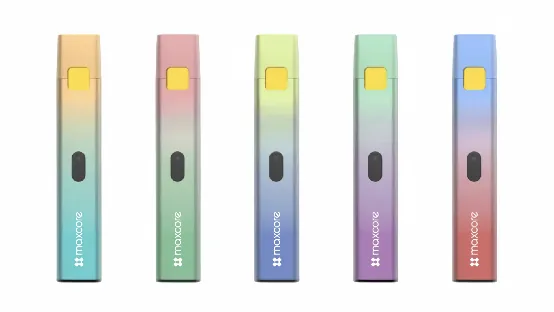
A well-planned vape CMF design process should therefore work alongside mechanical engineering rather than being treated purely as a visual exercise. Color, material, and finish decisions must coexist with wall thickness, component interfaces, assembly requirements, and the physical space needed for the oil system.
The goal is controlled and repeatable oil delivery under defined test conditions. Prototype testing can identify whether the selected architecture needs adjustments before tooling and volume production.
Match Heating Control to the Hardware
Heating is another major consideration. Research examining cannabis-extract cartridges has demonstrated that coil temperature can vary depending on the heating configuration and operating conditions. This makes the relationship between the heating element, oil saturation, airflow, and power supply important during product verification.
For thick oil, brands should avoid assuming that simply increasing power solves every delivery issue. Excessive or poorly controlled heating can introduce other engineering variables. Instead, teams can evaluate heating parameters systematically and establish operating conditions appropriate to the specific hardware and formulation.
Give Airflow Its Own Design Review
Airflow affects how the heating system operates and should be considered together with the oil path. The air channel, mouthpiece, heating chamber, and reservoir occupy the same compact product architecture, so changing one area can affect another.
This is where integrated vaping solutions can offer a useful development framework. Instead of adapting an unrelated battery or cartridge to a new formulation, engineers can evaluate airflow, heating, and physical packaging together.
Airflow should also be verified across representative production samples. Dimensional variation, assembly alignment, and blocked or partially restricted passages can change the finished device's behavior.
Choose Oil-Contact Materials Carefully
Materials deserve particular attention because components around the oil path can experience prolonged contact with the formulation. Buyers should identify the materials used in the reservoir, seals, heating assembly, coatings, and other relevant components.
Research into vape cartridge construction has found that heating elements, wicks, insulation, and other components can be exposed to both the liquid and inhaled airstream. For that reason, material selection should be documented and evaluated as part of the complete product rather than based only on a component's general industry use.
Integrate Battery and Device Controls
A thick-oil pod is still an electronic product, so battery and control architecture cannot be separated from the heating system. The power source should be matched to the intended electrical requirements, while charging and protection features should be evaluated during product verification.
FDA safety information notes that vape batteries can present overheating, fire, and explosion hazards and recommends using batteries specified for the relevant device. Consequently, electrical compatibility should be treated as an engineering requirement, not simply a purchasing specification.
Make Manufacturing Part of the Design
A prototype may perform well while production units introduce variation. Brands should therefore evaluate whether the selected pod architecture can be assembled consistently and whether critical dimensions, seals, heating components, and electrical interfaces can be controlled during manufacturing.
At Maxcore, we guide cannabis vape brands through a structured custom product-development process, from product definition and vape industrial design to verification, trial production, and manufacturing. Our OEM/ODM workflow keeps design, engineering, testing, production readiness, and delivery connected.
Our vape CMF design services can also support the product's visual direction while engineering requirements remain central. We consider color, material, and finish alongside the physical architecture so that the final concept is developed with manufacturability in mind.
Build the Product Around Verification
For thick cannabis oil, a suitable pod system is not defined by one feature. Oil compatibility, controlled delivery, heating architecture, airflow, materials, battery integration, and manufacturing consistency all need to work together.
At Maxcore, we use real product requirements and structured verification to develop vaping solutions around each project's specifications. A carefully coordinated vape CMF design process can then connect the technical platform with the intended product identity without compromising manufacturing considerations.
The strongest development process is therefore one that validates the complete system before volume production. By connecting formulation requirements, hardware engineering, testing, and manufacturing from the beginning, brands can make more informed decisions about whether a pod architecture is appropriate for their particular thick-oil application.