
What Makes an Empty All-in-One Vape Suitable for THC Distillate?
THC distillate presents a specific hardware challenge because its formulation and flow behavior must be matched with the device’s oil path, heating system, airflow, and power delivery. For cannabis vape brands, choosing an empty all-in-one (AIO) vape should therefore involve more than checking capacity or exterior appearance. The hardware needs to provide a controlled path from oil storage to atomization while remaining suitable for the intended formulation and production process.
For B2B buyers, this makes hardware compatibility an engineering question. ASTM D8376-21 specifically classifies cannabis extract vaporizers, while ASTM D8372-21 identifies characteristics and technologies found in extract vaporizer devices.
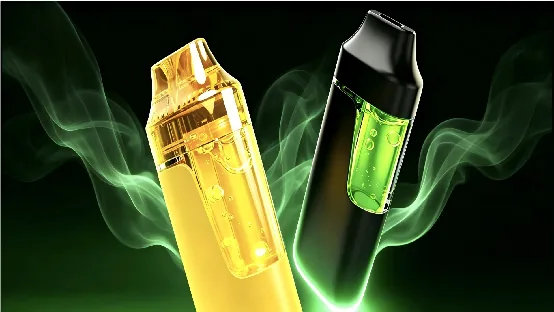
Oil Path Design Should Match THC Distillate
A suitable AIO begins with the reservoir and oil-feeding system. THC distillate can behave differently from less viscous vape formulations, so the relationship between the reservoir, oil inlet, wick or ceramic structure, and atomization area matters.
If the oil path cannot consistently supply the heating surface, vapor production can become uneven. Conversely, an overly aggressive feed may increase the possibility of flooding or leakage. For this reason, vaping solutions should be evaluated with the actual target formulation or a representative test material rather than selected solely from general device specifications.
We consider oil behavior early in development because the reservoir and atomizer need to work as one system. A design that looks appropriate on paper may require changes to the oil path once its interaction with a specific distillate formulation is tested.
Ceramic Heating Can Influence Atomization
The heating element is another major consideration. Ceramic atomizers are widely used in extract vaporizer hardware, but the word “ceramic” alone does not establish performance. Material structure, porosity, heating characteristics, oil absorption, and manufacturing consistency can all affect how the heating surface interacts with the distillate.
ASTM’s ongoing cannabis-device work identifies ceramic materials, atomizers, airflow, vapor paths, and device performance among areas where greater industry standardization is being developed. Its current work also highlights the importance of controlling ceramic manufacturing characteristics.
For brands comparing vaping solutions, the more useful question is therefore how the complete ceramic heating system performs with the target oil. Repeated testing can reveal whether vapor output remains reasonably consistent across successive activation cycles.
Power Delivery Needs to Match the Heating System
An AIO is an integrated electrical and thermal system. The battery and control system determine how energy reaches the heating element, while the atomizer converts that energy into heat for vaporization.
If power delivery is poorly matched to the heating structure, performance may vary between puffs or create excessive thermal stress. ASTM is also developing work addressing compatible voltage ranges, output power limitations, and ramp-up behavior for vaporizer devices.
This is particularly relevant when cannabis brands develop customized hardware rather than purchasing a generic platform. During our engineering process, we consider the relationship between the power system and atomization requirements instead of treating electrical and oil-system decisions as separate tasks.
Airflow and Vapor Path Matter Too
A consistent atomization system still needs an appropriately designed airflow and vapor path. Airflow influences how air moves across the heating area and how the resulting aerosol travels through the device. Internal geometry can therefore affect draw characteristics as well as the overall user experience.
The vapor path should also be considered in relation to materials that contact or sit close to the extract. ASTM has an active work item focused on substances used in materials for cannabis/hemp extract vaporizers, including considerations involving metal, ceramic, glass, plastic, polymer, corrosion, and extractable or leachable substances.
For B2B development, this means material selection should be documented rather than based simply on appearance or cost. A complete cannabis vape design services program should connect material selection with the intended formulation, thermal environment, and applicable market requirements.
Reservoir Geometry Supports Full-Cycle Performance
A suitable AIO should not only perform well when completely filled. Brands should evaluate how the device behaves as the distillate level decreases. Reservoir geometry, oil positioning, air compensation, and the relationship between the remaining oil and atomizer can influence late-stage performance.
Testing at different fill levels can help identify changes in draw behavior, vapor production, oil delivery, or leakage. This type of validation is especially useful for commercial buyers because production decisions should be based on repeatable evidence rather than a small number of favorable samples.
We incorporate verification into our development workflow so that design decisions can be evaluated before moving into larger-scale production. This helps connect prototype performance with manufacturing requirements.
Why Custom Development Can Improve Hardware Matching
Different cannabis products can impose different requirements on the same basic AIO architecture. Instead of assuming that one standard configuration is appropriate for every formulation, brands can define the intended oil, reservoir format, heating approach, airflow characteristics, and electrical system at the beginning of development.
Our custom vape development process covers product definition, vape industrial design, verification, trial production, and vape manufacturing. We keep these stages connected so that engineering decisions can be reviewed before the product enters commercial production.
For brands requiring cannabis vape design services, this integrated workflow can also simplify communication between product teams, engineers, testing personnel, and manufacturing partners. It creates a clearer path from an initial hardware concept toward a production-ready design.
From Distillate Compatibility to Production Readiness
An empty AIO suitable for THC distillate should be assessed as a complete system rather than as an isolated cartridge or heating component. Oil behavior, ceramic atomization, power delivery, airflow, vapor-path materials, reservoir geometry, and full-cycle performance all deserve consideration.
ASTM’s extract-vaporizer classification and guide provide useful industry terminology and categories, while its continuing standards work demonstrates that cannabis-device design and testing remain evolving areas.
At Maxcore, we use this system-level perspective to support custom vaping solutions, combining product definition, engineering verification, trial production, and manufacturing. For brands seeking cannabis vape design services, the objective is to align hardware development with the intended distillate and the practical requirements of commercial production.