What Should Be Included in a Cannabis Vape Hardware Manufacturer Evaluation Scorecard?
Choosing a hardware supplier should not come down to the lowest quotation or the appearance of a sample. For cannabis brands, a structured evaluation scorecard can make supplier comparisons more consistent by examining engineering, quality, customization, production, packaging, and commercial support against the same criteria. A well-designed scorecard also helps purchasing and product teams identify whether a supplier can support the current launch as well as future product development.
Start With Hardware Engineering Capability
The first section of a scorecard should examine how deeply a supplier understands vape hardware. Brands can assess ceramic heating technology, oil-delivery architecture, airflow design, battery systems, activation methods, and compatibility with different formulations.
When we develop hardware at Maxcore, we start with the oil rather than applying one heating configuration universally. Our R&D process considers oil composition, viscosity, flow behavior, and atomization characteristics before engineers select the ceramic substrate and heating-track design.
For brands evaluating a cannabis vape hardware manufacturer, this criterion can distinguish a company with genuine engineering capabilities from one primarily focused on assembling or reselling standardized components.
Score Formulation Compatibility
Oil compatibility deserves its own category because different cannabis formulations can behave differently during filling, storage, heating, and vaporization. A scorecard can therefore assess whether a supplier has experience testing distillate, live resin, rosin, and other relevant formulations.
We use real-oil testing to evaluate how ceramic heating and oil delivery interact with target formulations. Our POSTLESS® Technology uses a center-post-free, cotton-free structure developed for cannabis oil hardware, allowing the heating system and oil pathway to be considered together.
A useful scorecard should ask whether testing is performed with the brand's actual formulation, what operating parameters are evaluated, and whether engineering adjustments can be made when a formulation requires a different heating configuration.
Measure Quality and Production Control
A technically impressive sample does not guarantee consistent mass production. Brands should therefore assign points for incoming material inspection, process controls, assembly consistency, finished-product testing, traceability, and procedures for handling nonconforming units.
We recommend evaluating production capability at the same time as product specifications. Questions about manufacturing capacity, quality-control checkpoints, sampling methods, and engineering-change procedures can reveal whether a supplier is prepared to support commercial volumes.
When comparing vape pen manufacturers, procurement teams should also consider whether the supplier can maintain consistent specifications across production batches. Repeatability is particularly important when hardware has been qualified against a specific oil formulation.
Evaluate Customization and OEM/ODM Support
A supplier's customization capability can determine how easily a brand turns a hardware concept into a market-ready product. The scorecard can cover dimensions, tank capacity, mouthpiece design, activation, airflow, appearance, heating configuration, battery options, and other relevant hardware modifications.
We support OEM/ODM development so our partners can work with us on product requirements rather than being restricted to fixed catalog configurations. Our POSTLESS® platform can also be adapted to different suitable oil formulations and device formats.
For a cannabis vape hardware manufacturer, customization should not mean changing a logo or color only. Brands should assess whether the supplier can participate in engineering development, prototyping, testing, and design refinement.
Include Packaging as a Scored Category
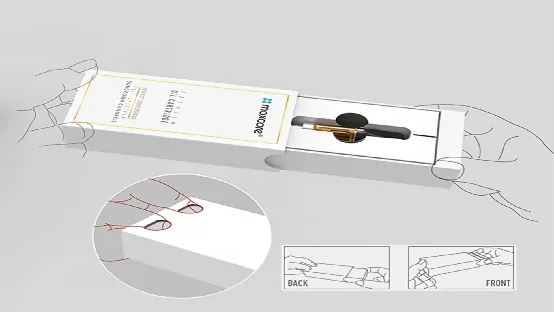
Packaging is sometimes evaluated separately from hardware, but integrating it into the scorecard can create a more complete view of a supplier's capabilities. Device dimensions, internal protection, presentation, labeling, and unboxing requirements all need to work together.
Our custom vape packaging design service translates brand identity into structure, graphics, color, finishes, and unboxing details. We develop packaging around cartridges, vape pens, pod systems, and all-in-one devices while considering device fit and manufacturing requirements.
For brands comparing vape pen manufacturers, packaging support can therefore be assessed alongside hardware customization. A supplier that can coordinate the device and its packaging may simplify communication between product development, purchasing, and manufacturing teams.
Assess Testing and Documentation
A supplier scorecard should also measure how clearly technical information is documented. Brands can review available product specifications, test procedures, material information, quality documentation, and records supporting the performance claims being made.
We believe technical communication should be specific enough for engineering and procurement teams to make informed decisions. Specifications should identify measurable characteristics rather than relying exclusively on broad descriptions such as “premium,” “advanced,” or “high performance.”
This is particularly useful when comparing several vape pen manufacturers. A supplier with detailed and consistent documentation makes it easier to compare products using objective criteria and identify gaps that require clarification before a purchase decision.
Score Commercial and Development Support
Price should have a place on the scorecard, but it should not be the only commercial criterion. Brands can separately evaluate minimum order quantities, lead times, sample availability, production capacity, communication, engineering response times, and support after the initial order.
A cannabis vape hardware manufacturer may offer a lower unit quotation while requiring more development work from the buyer. Another supplier may provide more engineering and customization support but quote a different price. A weighted scorecard allows the purchasing team to account for these differences explicitly.
We also recommend recording the assumptions behind every score. This makes supplier reviews easier to revisit when requirements change and prevents a single attractive quotation from dominating a broader technical assessment.
Build a Scorecard Around Your Product Roadmap
A useful evaluation scorecard should reflect the brand's actual priorities. Engineering capability, formulation compatibility, manufacturing quality, customization, packaging, documentation, testing, lead time, and commercial support can each receive defined criteria and evidence requirements.
At Maxcore, we combine hardware development, POSTLESS® technology, ceramic atomization research, OEM/ODM support, and custom packaging capabilities to serve brands developing cannabis vape products. Our approach connects product engineering with the practical requirements of commercialization.
For brands assessing a cannabis vape hardware manufacturer, a structured scorecard creates a more transparent comparison than price or product appearance alone. By applying the same criteria to every supplier, teams can identify the capabilities that matter to their launch, document their reasoning, and select hardware partners based on the complete requirements of the product roadmap.