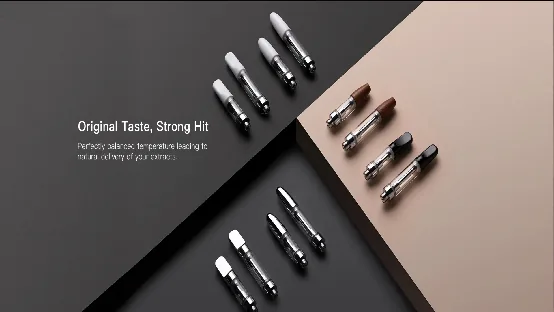
What Should Buyers Compare When Ordering Empty Cannabis Vape Cartridges in Bulk?
Bulk cartridge purchasing is not simply a unit-price exercise. For cannabis brands, the hardware must match the viscosity and composition of the oil, support consistent filling, protect the product during storage and shipping, and fit the intended battery system. Buyers also need to consider materials, quality controls, customization, and production capacity. A structured comparison helps teams evaluate total value rather than simply choosing the lowest quotation.

Oil Compatibility and Heating Performance
First compare the heating system with the intended extract. Cannabis oils can differ substantially in viscosity and formulation, so a cartridge that performs well with one formulation may not behave identically with another. Heating-element design, pore structure, airflow, and oil-feed characteristics can influence vapor production, flavor, clogging, and leakage.
Ceramic heating systems are widely used in the market because their design can support controlled oil delivery and vaporization. CCELL, for example, describes its ceramic technology as being designed for different oil viscosities and highlights compatibility with distillates and higher-viscosity extracts. Because performance is product-specific, buyers should request evidence for their own formulations.
Materials and Contact Surfaces
Materials deserve the same attention as heating performance. Buyers should identify the tank material, center post, seals, mouthpiece, and heating-element materials, especially where components can contact the extract or experience elevated temperatures. Glass and thermoplastic housings are common cartridge approaches, while stainless steel and ceramic may appear in internal components.
ASTM’s current work on restricted substances for cannabis and hemp extract vaporizers specifically considers materials that may be in direct or indirect contact with liquid extract, including metals, ceramics, glass, plastics, and polymers. Material documentation is therefore important for supplier evaluation.
Capacity, Threading, and Filling Workflow
Capacity should be compared against the product portfolio rather than selected in isolation. Common cartridge formats include 0.5 ml and 1 ml, while other sizes are also available. Capacity affects fill volumes, packaging, inventory, and SKUs.
Thread compatibility is another practical consideration. The 510 thread is a common cartridge-to-battery connection, but buyers should confirm dimensional compatibility with their existing batteries and production equipment. Mouthpiece and tank geometry can also affect filling, sealing, packaging, and handling.
Leak Resistance and Quality Consistency
A bulk order magnifies small quality problems. If a cartridge has inconsistent seals, airflow, or oil-feed behavior, a low defect rate can still translate into substantial rework when thousands of units are purchased. Buyers should therefore compare leakage testing, dimensional tolerances, incoming inspection, sampling procedures, and batch traceability.
Quality documentation should be specific, not broad. Ask how suppliers inspect heating elements, tanks, seals, threads, and finished assemblies. Where regulatory requirements apply, brands should also understand testing obligations for the cannabis product itself. For example, California requires cannabis goods to undergo laboratory testing for contaminants and other characteristics before sale, with results reported on a Certificate of Analysis.
Customization and Brand Requirements
For established brands, standard hardware may not provide enough differentiation. Custom colors, finishes, mouthpieces, branding elements, packaging interfaces, and structural details can help align the cartridge with a broader product identity. However, customization should be assessed alongside tooling costs, minimum order quantities, lead times, and quality-control requirements.
Our Maxcore OEM approach starts with product requirements rather than treating customization as a cosmetic step. We support custom vape hardware development from user research through color, material, and finish (CMF) decisions and vape branding, with the goal of turning product concepts into manufacturable hardware. This approach can help buyers connect design decisions with production realities.
Total Cost and Supply Reliability
Unit price matters, but it should be compared with total procurement cost. Buyers should examine tooling, sampling, packaging, freight, defect allowances, replacement policies, payment terms, and expected lead times. A cheaper cartridge may cost more if inconsistent production creates filling delays or inspection work.
Supply reliability matters for recurring programs. Buyers can ask about production capacity, quality-control checkpoints, raw-material sourcing, batch consistency, and contingency planning. For growing brands, reproducing an approved design across future orders can matter as much as the initial quotation.
Using a Structured Vaping Solutions Comparison
A useful purchasing sheet can score factual criteria without turning the process into a simple price ranking. Record each supplier’s capacity options, connection type, materials, heating technology, oil compatibility evidence, leakage controls, customization scope, MOQ, lead time, quality documentation, and after-sales terms. Then test representative samples with the actual oil formulation before committing to a large production run.
For brands seeking an integrated development route, our Maxcore OEM service can connect design and manufacturing considerations earlier in the process. We can work around the intended user experience, CMF direction, branding requirements, and manufacturability instead of treating the cartridge as an isolated component. This helps when a brand needs differentiated vaping solutions across product lines.
Building a More Reliable Bulk Procurement Decision
The strongest bulk purchasing decision comes from comparing technical fit, quality controls, commercial terms, and manufacturing capability together. Buyers should validate cartridge performance with their own oil, document material and quality requirements, and confirm that the supplier can reproduce the approved configuration at scale.
We approach Maxcore OEM projects with that same development logic: define the product requirements, translate them into manufacturable hardware, and align design, materials, and production considerations before volume ordering. For cannabis brands evaluating vaping solutions, a disciplined comparison process can reduce avoidable procurement risks while creating a clearer path from concept to repeatable production.