How Do You Compare Tank Materials for Cannabis Vape Cartridges?
Tank material is more than a cosmetic choice when developing a cannabis vape cartridge. The reservoir must contain the formulation reliably while working with the heating system, seals, mouthpiece, and airflow path. For B2B buyers, comparing glass, thermoplastic, and ceramic constructions requires attention to oil compatibility, durability, visibility, manufacturing, and quality control. A structured material review can help brands select practical vaping solutions rather than judging cartridges by appearance alone.
Start With the Oil and Formulation
The intended oil should be the first reference point when comparing tank materials. Cannabis extracts can differ substantially in viscosity and composition, so a material that works with one formulation should not automatically be considered suitable for another.
Commercial cartridge ranges demonstrate that both borosilicate glass and thermoplastic bodies are used in oil-vaporization hardware. CCELL, for example, currently offers borosilicate glass and BPA-free thermoplastic 510 cartridges, including versions specifically marketed for difficult-to-work-with oils such as live rosin.
For our development projects, we therefore treat material selection as part of the complete vaping hardware solutions process. The reservoir, heating element, seals, and actual oil formulation need to be evaluated together rather than separately.
Compare Glass for Chemical Resistance and Visibility
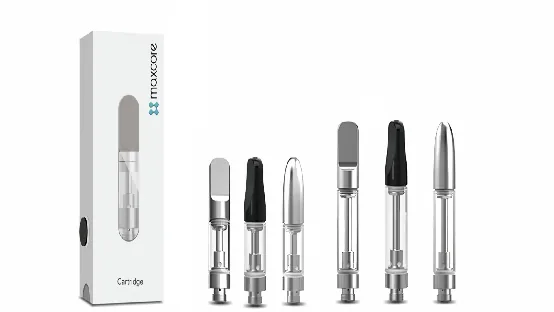
Borosilicate glass is a common choice for cartridge reservoirs. Its transparency allows brands and users to see the remaining oil, while its established resistance to corrosion makes it attractive for oil-contact applications. Current commercial examples include 510 cartridges using borosilicate glass bodies with ceramic heating elements and stainless-steel center posts.
For brands that emphasize visible oil presentation, glass can also support a premium product appearance. However, material selection should consider mechanical handling throughout filling, assembly, packaging, and transportation. A material's technical advantages do not eliminate the need for drop, handling, and production-line testing.
Glass can also influence industrial design decisions. Wall thickness, geometry, mouthpiece attachment, and external protection need to be considered when creating vaping solutions intended for commercial distribution.
Evaluate Thermoplastic for Manufacturing Flexibility
Thermoplastic construction provides a different set of considerations. Commercial 510 cartridges are available with BPA-free thermoplastic bodies, and manufacturers position these designs around characteristics such as impact and corrosion resistance.
For B2B buyers, this can make thermoplastic worth investigating where durability, weight, form factor, or manufacturing requirements are priorities. The decision should still be based on the exact material grade and intended oil-contact application rather than the generic term “plastic.”
Documentation is therefore essential. Buyers should request the material specification, identify the components exposed to oil, and establish appropriate testing requirements. The material should be evaluated as part of the complete vaping hardware solutions architecture, including seals and heating components.
Understand What Ceramic Does—and Does Not—Mean
Ceramic deserves careful treatment because it may refer to different parts of a cartridge. A cartridge can have a ceramic heating element while using glass or thermoplastic for the tank. Other designs may incorporate ceramic into the center structure or mouthpiece.
CCELL's current product range illustrates this distinction: its Ceramic-EVOMAX combines a borosilicate glass body with a ceramic center post, while other cartridges pair ceramic heating technology with either glass or thermoplastic housings.
For procurement teams, asking simply whether a cartridge is “ceramic” is therefore insufficient. The more useful questions are which components are ceramic, which materials contact the oil, and how the heating architecture interacts with the selected reservoir.
Compare Durability Across the Production Cycle
Tank material should be evaluated beyond the finished product. Consider how the cartridge behaves during component handling, automated or semi-automated filling, capping, packaging, shipping, and storage.
A suitable design needs consistent dimensions and secure interfaces. Poor fit between the tank, seals, mouthpiece, or heating assembly can create leakage or assembly problems regardless of the reservoir material.
We recommend testing representative production samples rather than relying only on laboratory samples. Batch-level inspection can identify dimensional variation and assembly issues before a large quantity of oil is committed to production.
Look at Visibility, Weight, and Brand Requirements
Material selection also affects the commercial design brief. Glass provides direct visibility of the oil, which can be useful when the product presentation depends on showing fill level or formulation appearance. Thermoplastic can offer alternative possibilities for weight, shape, and exterior integration.
These factors should be balanced against the brand's packaging, filling equipment, storage conditions, and target market. A technically suitable tank can still create operational problems if its geometry does not fit existing production processes.
This is why vaping hardware solutions should be developed around the complete product rather than selected as isolated components. Material, geometry, heating, and assembly all influence one another.
Build Testing Around the Finished Cartridge
Material comparison should finish with actual performance testing. A structured program can evaluate oil compatibility, leakage, dimensional stability, heating consistency, airflow, activation, and behavior after storage or transportation simulation.
Testing should also include the actual formulation whenever possible. Public-health authorities have documented concerns involving THC-containing vaping products and substances such as vitamin E acetate; the FDA and CDC specifically state that vitamin E acetate should not be added to vaping products.
For manufacturers, this reinforces the importance of knowing exactly what materials and formulations enter the finished product and maintaining appropriate quality documentation.
Connect Material Selection With OEM/ODM Development
At Maxcore, we guide cannabis vape brands through a structured custom product development process, from product definition and vape industrial design to verification, trial production, and vape manufacturing. Our OEM/ODM workflow keeps engineering, testing, production readiness, and delivery aligned.
We can evaluate tank material alongside the intended oil, heating architecture, physical design, and manufacturing requirements. This approach helps avoid choosing a reservoir material simply because it is familiar or visually attractive.
Choosing Materials With the Whole Product in Mind
There is no universal tank material that fits every cannabis cartridge project. Glass, thermoplastic, and ceramic-related constructions each bring different considerations for oil compatibility, visibility, durability, design, and manufacturing. For brands developing dependable vaping solutions, the practical choice comes from testing the complete cartridge against its intended application.
We at Maxcore support this evaluation through coordinated OEM/ODM development, helping brands turn material requirements into tested vaping hardware solutions that are aligned with product design and manufacturing objectives.