What Makes Live Resin Hardware Requirements Different from Distillate?
Live resin and distillate may both enter the same 510-style ecosystem, but they do not necessarily behave the same way inside a cartridge. The difference matters because oil composition, viscosity, terpene content, and flow behavior can affect how a device feeds material to its heating element. Selecting cannabis vape hardware therefore requires more than matching a thread size or battery. The formulation and hardware need to be evaluated as one system.
Understanding the Oil Before Choosing Hardware
Distillate is highly refined and commonly formulated with cannabis-derived or other terpenes. Research on cannabis vaping notes that added terpenes can reduce viscosity, helping the oil move toward the atomizer through a wicking system. That makes flow behavior a central consideration when specifying hardware for distillate products.
Live resin is different because it is generally produced to preserve a broader profile of compounds from freshly harvested cannabis. Its composition can therefore be less standardized from one formulation to another. For manufacturers, that variability means one cartridge should not automatically be assumed to perform identically with another.
Viscosity Changes the Hardware Conversation
Viscosity is one of the most practical differences for hardware selection. A thicker formulation may move more slowly through a feed path, while a thinner formulation can reach the heating surface more readily. Research has shown that sufficiently low viscosity is important for cartridge systems that rely on wicking to deliver oil to the atomizer.
For live resin programs, manufacturers should examine oil viscosity across the expected operating temperature range rather than testing only at room temperature. Feed-hole dimensions, ceramic porosity, oil-contact area, and reservoir geometry can all influence how reliably the formulation reaches the heating element. These details should be validated together instead of optimized independently.
Terpenes Also Affect Device Behavior
Terpene content adds another layer to formulation-hardware matching. Terpenes can influence viscosity and sensory characteristics, but excessive fluidity can also create unwanted leakage or feeding behavior. Recent research on cannabis concentrates highlights the need to balance viscosity rather than simply making a formulation as thin as possible.
That balance matters when developing cannabis vape hardware for live resin. A design should provide adequate oil delivery without allowing the formulation to flood the heating area or move unpredictably through the air path. For OEM and ODM teams, testing with the intended formulation is more meaningful than relying on a generic specification.
Heating Control Matters for Both Oils
The heating element must also be considered alongside oil flow. Scientific studies of cannabis extract vaporization have demonstrated that cartridge temperature can vary substantially with device design, electrical settings, and operating conditions. When the heating surface is not adequately supplied with liquid, localized overheating can become a performance concern.
For live resin, controlled and repeatable heating is especially relevant because manufacturers are often trying to preserve a formulation's intended sensory profile while maintaining consistent aerosol production. Distillate may be more forgiving in some formulations, but it still requires a matched power range and heating element. Neither oil should be treated as universally compatible with every battery and cartridge.
Why Ceramic Design Can Matter
Ceramic heating structures can offer manufacturers a way to engineer the contact between the heating surface and cannabis oil. Research examining commercial cannabis cartridges has documented ceramic-based heating elements as a common design approach. Their geometry, porosity, and interaction with the oil can influence heat transfer and liquid delivery.
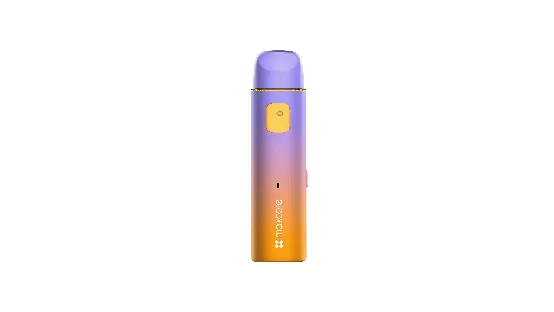
At Maxcore, we approach this interface as a complete system. Our patented P30 ceramic coil is designed around smoother vapor, purer taste, and consistent performance. For B2B customers evaluating different formulations, this type of ceramic architecture provides a platform for testing how heating and oil delivery work together rather than treating the coil as an isolated component.
Designing for Controlled User Experience
A successful device also needs to provide predictable operation. Live resin and distillate can respond differently to changes in power, temperature, and preheating. A fixed output may not provide the same experience across formulations, particularly when viscosity and flow change.
Our Meto platform incorporates on-demand preheating and customizable power levels, giving manufacturers a way to tune device behavior to the formulation. Its POSTLESS® design, pocket-sized form factor, and P30 ceramic coil are also positioned around a compact hardware architecture. The objective is controlled delivery matched to the oil.
Validation Should Start With the Formulation
For B2B development teams, the reliable workflow begins with the oil. Measure viscosity and terpene composition, define the temperature range, then evaluate filling, saturation, puff performance, leakage, and consistency. Repeat those tests with the selected battery settings and cartridge geometry.
This approach helps distinguish formulation problems from hardware problems and creates useful engineering data for production decisions. Instead of assuming one cartridge can serve every SKU, manufacturers can establish clear operating windows for each formulation.
Building a Better Match
The key difference between live resin and distillate is not simply thickness or complexity. Their characteristics can change how oil moves, contacts the heater, and responds to power. That is why cannabis vape hardware should be evaluated according to the specific oil rather than selected as a universal component.
At Maxcore, we combine ceramic heating technology, adjustable power behavior, and formulation-oriented testing to help B2B partners develop hardware around real product requirements. With the right validation process, vape hardware can be engineered for consistent oil delivery, controlled heating, and a more predictable finished-device experience.