Which Oil Properties Should You Share with a Cannabis Vape Hardware Supplier?
A cannabis vape hardware supplier cannot properly evaluate a cannabis oil formulation from a product name alone. Distillate, live resin, rosin, and other extracts can differ substantially in viscosity, cannabinoid concentration, terpene content, and thermal behavior. Sharing these properties early gives an engineering team the information needed to assess oil delivery, heating, airflow, and filling requirements. A clear oil profile can shorten compatibility testing and reduce prototype changes.

Start with Viscosity and Test Conditions
Viscosity should be one of the first specifications on your data sheet. It describes resistance to flow, affecting filling, oil movement, and replenishment of the heating surface. Research published by the American Chemical Society shows that cannabis extract viscosity varies with composition and temperature, while terpene content can strongly affect measured viscosity.
However, a single viscosity number is incomplete. Tell your cannabis vape hardware supplier the test temperature, measurement method, units, and, where available, whether the material behaves differently as shear changes. Temperature matters because cannabis oils can become substantially more or less fluid as they warm. Reporting viscosity at temperatures relevant to filling and use makes laboratory results more useful for hardware selection.
Describe Cannabinoid and Extract Composition
Share the major cannabinoid profile and the general extract type. For example, identify whether the formulation is a distillate, live resin, rosin, or another concentrate, and provide the relevant THC, CBD, or other cannabinoid concentrations from your laboratory data.
Two oils with similar appearance may not behave identically. Published measurements of cannabis extracts have found substantial variation in density and viscosity, and the study specifically identified terpene content as an important influence on viscosity. A supplier can use this information to decide which ceramic platform, oil path, and operating conditions deserve testing.
Give the Terpene Profile and Percentage
Terpenes deserve their own line on the formulation sheet. They influence aroma and flavor, but they can also change the physical behavior of a cannabis oil. Research in the Journal of Chemical & Engineering Data found that terpene content strongly affected the viscosity of CBD- and THC-containing samples.
Share the total terpene percentage and, when possible, the major terpene components. Also disclose whether terpenes are cannabis-derived, botanical, or part of another system. This information helps the engineering team understand the formulation rather than treating all oils with the same nominal viscosity as interchangeable.
Explain Additives, Dilution, and Processing
A hardware team should know everything intentionally added to the oil. List diluents, thinning agents, flavor components, or other formulation aids, together with their concentrations. Do not rely on phrases such as “standard vape oil,” because the same commercial category can cover materially different compositions.
Also report relevant processing history, including filtration, winterization, distillation, blending, or heating. Research has shown that extraction and processing conditions can influence the chemical composition of cannabis concentrates. This history can help explain flow or performance changes between batches.
Share Thermal Behavior and Use Conditions
Heating requirements for a cannabis vape pen should be discussed alongside oil properties. Provide known softening, melting, or temperature-dependent flow behavior, plus the intended operating range. Do not assume that a higher heater setting automatically solves a high-viscosity problem.
Vaporization studies have demonstrated that cartridge temperature can become very high under certain operating conditions, and heating conditions can affect chemical transformations. Hardware evaluation should therefore consider oil composition, ceramic heating, power, airflow, and puff conditions together.
Our Approach to Oil-Hardware Matching
At Maxcore, we treat the oil profile as an engineering input rather than an afterthought. Our POSTLESS® architecture removes the traditional center post from the oil-contact pathway, while our ceramic platforms support different oil formulations. We use formulation information to guide compatibility discussions and determine which hardware configuration merits practical testing.
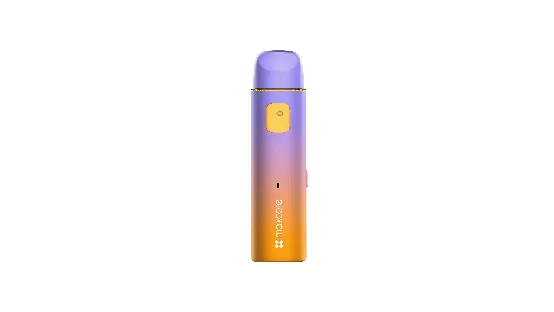
Our Gemini Magnetic Postless Pod System illustrates how hardware details can be tied to a defined oil application. It uses a POSTLESS P30 ceramic coil, a 2.0 ml tank, inhale activation, a 260 mAh battery, 6W output, Type-C charging, and food-grade PCTG and PC tank materials. The system also uses a magnetic battery-and-pod connection and built-in child-lock design.
Build a Complete Supplier Data Sheet
Before sending samples, compile viscosity, test temperature, cannabinoid concentrations, terpene percentage and profile, additives, extract type, processing history, and relevant thermal information. Add the target fill volume, expected shelf conditions, and intended use pattern when those parameters are already known.
This gives a cannabis vape pen supplier a clearer starting point. It also makes comparisons easier when formulations change during development. For cannabis vape hardware projects, better input data can make prototype testing more focused, so engineers can investigate specific formulation-hardware interactions instead of guessing at the cause.
From Oil Data to Hardware Decisions
Good hardware matching starts before the first cartridge or pod is filled. With a complete oil profile, we can discuss material, heating, airflow, and oil-delivery considerations more precisely. For brands and processors developing a cannabis vape pen, transparent formulation data supports a more structured path from sample evaluation to production-ready hardware.
At Maxcore, we combine POSTLESS® design and ceramic heating technology with B2B OEM/ODM development, helping partners evaluate hardware around their oils. Sharing the right oil properties at the beginning gives both sides a stronger technical foundation for compatibility testing, refinement, and commercial production.