When Should You Choose 510 Cartridges Over All-in-One Cannabis Vapes?
Choosing between a 510 cartridge and an all-in-one format affects more than the appearance of a finished vape. For cannabis brands, the two architectures differ in battery integration, customization, packaging, supply-chain management, and product positioning. Understanding these differences helps procurement and product teams define suitable vaping solutions before committing to a hardware platform. The right choice depends on the intended product architecture, market requirements, and manufacturing strategy.
What Defines a 510 Cartridge?
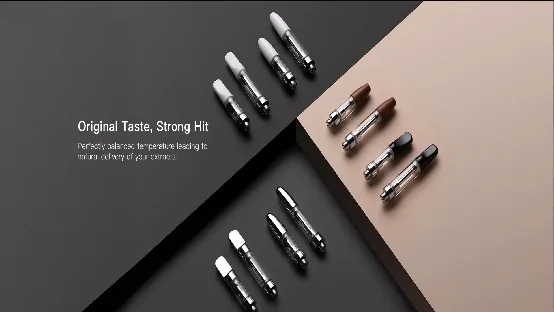
A 510 cartridge is generally a replaceable cartridge designed around a standardized threaded connection. The cartridge contains the reservoir, heating assembly, mouthpiece, and related components, while the battery is supplied separately.
The separation between cartridge and battery creates a modular product architecture. A brand can develop or source a cartridge while maintaining compatibility with an appropriate 510 battery platform. This can simplify certain aspects of product development because the two major hardware sections can be considered separately.
For businesses evaluating custom vape product development, that modularity can also provide greater flexibility when developing different cartridge configurations or exterior designs while retaining a compatible battery ecosystem.
How All-in-One Vapes Differ
An all-in-one vape integrates the cartridge and battery into a single disposable or self-contained device. The user receives one complete unit rather than a separate cartridge and battery.
This architecture can simplify the consumer-facing experience because there are fewer individual components to manage. From a product-development perspective, however, the battery, reservoir, heating system, airflow path, charging or activation system, and enclosure must be considered as one integrated design.
That integration can be useful when a brand wants a highly specific form factor or a complete device designed around one product concept. It also means changes to one major component can affect other parts of the overall design.
When Modular Hardware Makes Sense
A 510 cartridge can be worth considering when a business values modularity. Separate cartridge and battery components allow companies to approach hardware development as a system of compatible parts rather than one permanently integrated product.
This can be relevant for brands managing multiple product configurations. A suitable cartridge architecture may potentially be paired with different compatible battery designs, subject to the applicable mechanical, electrical, regulatory, and supplier requirements.
For vaping solutions, this modular approach can also affect inventory planning. Cartridges and batteries may be managed as separate components, although the commercial benefits depend on order volumes, compatibility requirements, packaging, and the company's distribution model.
When an All-in-One Format May Be Appropriate
An all-in-one format may suit a product strategy centered on a self-contained device. Because the battery and cartridge are integrated, the external design can be developed as one cohesive enclosure.
This can give product teams more control over the overall appearance and user interface. However, the integrated architecture also creates additional relationships between components that must be addressed during product development and validation.
For example, enclosure dimensions can influence battery selection and internal component arrangement. Likewise, changes to the reservoir or heating assembly may affect the available internal space. These considerations make early engineering coordination important for custom vape product development.
Compare the Supply-Chain Implications
The choice also affects procurement. With a 510 system, cartridge and battery sourcing can potentially be managed separately. This may provide additional flexibility for companies that already have established battery suppliers or want to develop multiple compatible product configurations.
An all-in-one product consolidates more components into one finished unit. That can simplify the number of consumer-facing parts but may make the finished product more dependent on one integrated manufacturing configuration.
Neither model automatically produces a simpler supply chain. The appropriate structure depends on production volume, component availability, packaging requirements, quality procedures, and the degree of customization required.
Consider Product Development and Testing
Hardware selection should happen alongside product requirements rather than after the formulation and branding decisions have already been finalized. Cartridge architecture, battery configuration, materials, and packaging all need to be considered within the applicable market and regulatory framework.
At Maxcore, we combine market and user research with oil-focused R&D, custom hardware design and engineering, scalable manufacturing, and post-production support. This coordinated OEM/ODM workflow allows our team to address the hardware architecture as part of a broader development process.
Our role in vaping solutions therefore extends beyond supplying an individual component. We work with customers to connect development requirements with manufacturing considerations, helping establish a defined path from an approved concept toward commercial production.
Match the Format to the Business Model
A 510 cartridge can make sense when modularity, component flexibility, and compatibility with an established 510 ecosystem are important considerations. An all-in-one format can be considered when a business prioritizes an integrated device architecture and a self-contained product experience.
The decision should also account for target markets, applicable regulations, expected volumes, packaging, inventory management, battery requirements, and customization objectives. These factors can be more consequential than the basic visual difference between the two formats.
Choosing a Hardware Architecture With Purpose
The choice between 510 cartridges and all-in-one cannabis vapes is ultimately a product-architecture decision. Neither format should be selected solely because it is familiar or visually attractive. Procurement and engineering teams can compare modularity, integration, customization, supply-chain structure, and validation requirements against their specific commercial objectives.
For brands planning custom vape product development, Maxcore brings market research, oil-focused R&D, custom vape design and engineering, scalable vape manufacturing, and post-production support into one OEM/ODM workflow. This integrated approach helps businesses evaluate vaping solutions according to their product requirements and manufacturing plans.